Tuesday, July 28, 2015

Meaning of open source

Open source software is software whose source code is available for modification or enhancement by anyone. "Source code" is the part of software that most computer users don't ever see; it's the code computer programmers can use to change how a piece of software works.

 The most widely used open source data base is Ubuntu. It is a Linux based operating system and is distributed free along with the source code. Its desktop looks somewhat similar to that of Windows, with window controls and icons

Introduction


Open source doesn't just mean access to the source code. The distribution terms of open-source software must comply with the following criteria:

1. Free Redistribution

The license shall not restrict any party from selling or giving away the software as a component of an aggregate software distribution containing programs from several different sources. The license shall not require a royalty or other fee for such sale.

2. Source Code

The program must include source code, and must allow distribution in source code as well as compiled form. Where some form of a product is not distributed with source code, there must be a well-publicized means of obtaining the source code for no more than a reasonable reproduction cost preferably, downloading via the Internet without charge. The source code must be the preferred form in which a programmer would modify the program. Deliberately obfuscated source code is not allowed. Intermediate forms such as the output of a pre-processor or translator are not allowed.

3. Derived Works

The license must allow modifications and derived works, and must allow them to be distributed under the same terms as the license of the original software.

4. Integrity of The Author's Source Code

The license may restrict source-code from being distributed in modified form only if the license allows the distribution of "patch files" with the source code for the purpose of modifying the program at build time. The license must explicitly permit distribution of software built from modified source code. The license may require derived works to carry a different name or version number from the original software.

5. No Discrimination Against Persons or Groups

The license must not discriminate against any person or group of persons.

6. No Discrimination Against Fields of Endeavor

The license must not restrict anyone from making use of the program in a specific field of endeavor. For example, it may not restrict the program from being used in a business, or from being used for genetic research.

7. Distribution of License

The rights attached to the program must apply to all to whom the program is redistributed without the need for execution of an additional license by those parties.

8. License Must Not Be Specific to a Product

The rights attached to the program must not depend on the program's being part of a particular software distribution. If the program is extracted from that distribution and used or distributed within the terms of the program's license, all parties to whom the program is redistributed should have the same rights as those that are granted in conjunction with the original software distribution.

9. License Must Not Restrict Other Software

The license must not place restrictions on other software that is distributed along with the licensed software. For example, the license must not insist that all other programs distributed on the same medium must be open-source software.

10. License Must Be Technology-Neutral

No provision of the license may be predicated on any individual technology or style of interface


Sunday, July 26, 2015

client serer architecture

following are the some differences between client server architecture and two tier architecture:-

 
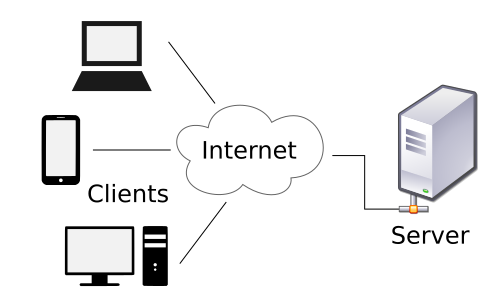
 The client–server model of computing is a distributed application structure that partitions tasks or workloads between the providers of a resource or service, called servers, and service requesters, called clients.
 

Two-Tier Architecture:

 
The two-tier is based on Client Server architecture. The two-tier architecture is like client server application. The direct communication takes place between client and server. There is no intermediate between client and server. Because of tight coupling a 2 tiered application will run faster.
Let’s take a look of real life example of Railway Reservation two-tier architecture:
Let’s consider that first Person is making Railway Reservation for Mumbai to Delhi by Mumbai Express at Counter No. 1 and at same time second Person is also try to make Railway reservation of Mumbai to Delhi from Counter No. 2
If staff from Counter No. 1 is searching for availability into system & at the same staff from Counter No. 2 is also looking for availability of ticket for same day then in this case there is might be good change of confusion and chaos occurs. There might be chance of lock the Railway reservation that reserves the first.
But reservations can be making anywhere from the India, then how it is handled?
So here if there is difference of micro seconds for making reservation by staff from Counter No. 1 & 2 then second request is added into queue. So in this case the Staff is entering data to Client Application and reservation request is sent to the database. The database sends back the information/data to the client.
In this application the Staff user is an end user who is using Railway reservation application software. He gives inputs to the application software and it sends requests to Server. So here both Database and Server are incorporated with each other, so this technology is called as “Client-Server Technology“.

The Two-tier architecture is divided into two parts:
1) Client Application (Client Tier)2) Database (Data Tier)
On client application side the code is written for saving the data in the SQL server database. Client sends the request to server and it process the request & send back with data. The main problem of two tier architecture is the server cannot respond multiple request same time, as a result it cause a data integrity issue.
Advantages:
  1. Easy to maintain and modification is bit easy
  2. Communication is faster
Disadvantages:
  1. In two tier architecture application performance will be degrade upon increasing the users.
  2. Cost-ineffective